
The top secret formula to master your breathing?
- Roberto Folleri
- Oct 24, 2024
- 3 min read
Diaphragmatic Breathing and Proper Posture: The Key to Core Stability
Breath and Posture

How long can you go without food? Weeks, maybe. How long can you go without water? Days, sure. But how long can you last without breathing? A few minutes, max. And yet, we treat breathing like the least of our concerns, when it should be our first priority!
Here’s the reality:
The better you become at consciously controlling your diaphragm, the more efficient you are at delivering oxygen where and when it’s needed most. The diaphragm is the muscle that develops earlier than the rest—almost like the father of your body’s orchestra. It coordinates everything: your posture, the elegance of your movement, the function of your internal organs, and even the chemistry of your emotions. That’s right, the way you feel is in sync with how you breathe.
Intra Abdominal Pressure: the airbag system!
Now that we’ve uncovered the basic frame of breathing, let’s dive into a more colorful picture of how breathing and the diaphragm shape your posture—and how ignoring this can turn you into a human popcorn machine, crackling with back and joint pain every time you move.
Your core isn’t just about rock-hard abs. It’s about building central stability that starts with the diaphragm.Why? Because the diaphragm’s ability to work in harmony with your abdominal organs creates a balanced intra-abdominal pressure (IAP), which acts as your natural stabilizer. It’s like the foundation of a building—without it, everything above will eventually crumble!


“Intra-abdominal pressure is crucial for spine stability. It acts as an internal brace, reducing the load on the spine and supporting the muscles in the core. The more efficiently the diaphragm and abdominal muscles work together, the greater the stability and the lower the chance of injury.” – Dr. Stuart McGill
The hydropneumatic model:
But here’s where it gets cool: diaphragmatic breathing activates the fascia surrounding your abdominal organs, making your core function like a well-oiled hydropneumatic system. From my personal experience as an osteopath, this is the most overlooked aspect of the connection between breathing and core stability. People often focus on external muscle work, but the deep, internal relationship between the diaphragm and the fascia is what truly creates that central stability and power. If this connection isn't well-established, your body misses out on its most fundamental stabilizing force.
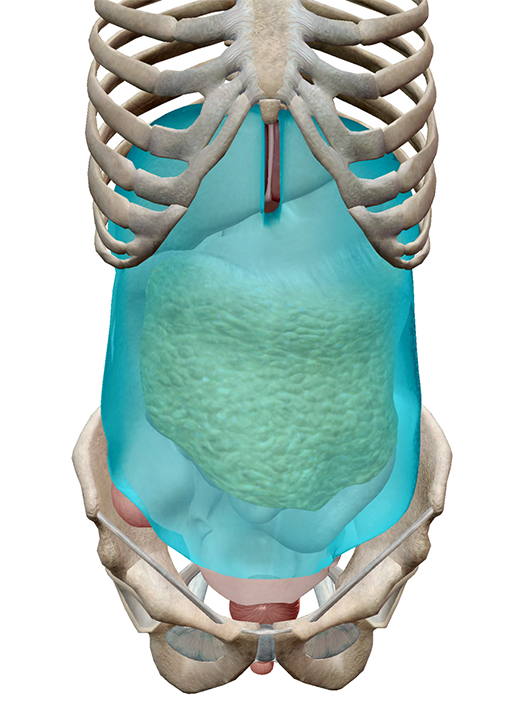


Think of it as a set of pulleys and cables holding everything together—if you engage it right, you create a power source that stabilizes you from the inside out. Now, don’t think the diaphragm does all this alone.
The corset:
Like every muscle, it needs a counterforce! That’s where your abdominal corset comes in, providing the opposition to the diaphragm's push during breathing, which balances the expansion of your organs. Without this, the pressure created would be like an uncontained explosion—chaos, right?
And here’s the real magic: if you get your diaphragm working properly, your shoulders and hips (those “ball and socket” joints) are finally free to do what they were meant to—move freely without being locked up by tension or stiffness. Tension in our shoulder and hips will mafinest as rigidity and discomfort intto your neck and lower back area. Central stability, peripheral mobility—that’s the game.


Circulation:
And let’s not forget: when things aren’t moving right, all the “cables” in your body—arteries, lymph, veins—get squeezed. The result? Blocked circulation, sluggish lymphatic drainage, and added stress to your body’s systems.

The secret formula:
So, if your breathing is off, chances are, your health is too.Take charge of your posture and breathing to unlock that powerhouse potential!


Comments